
How Often Manicures Are Needed: Schedule for Healthy Nails
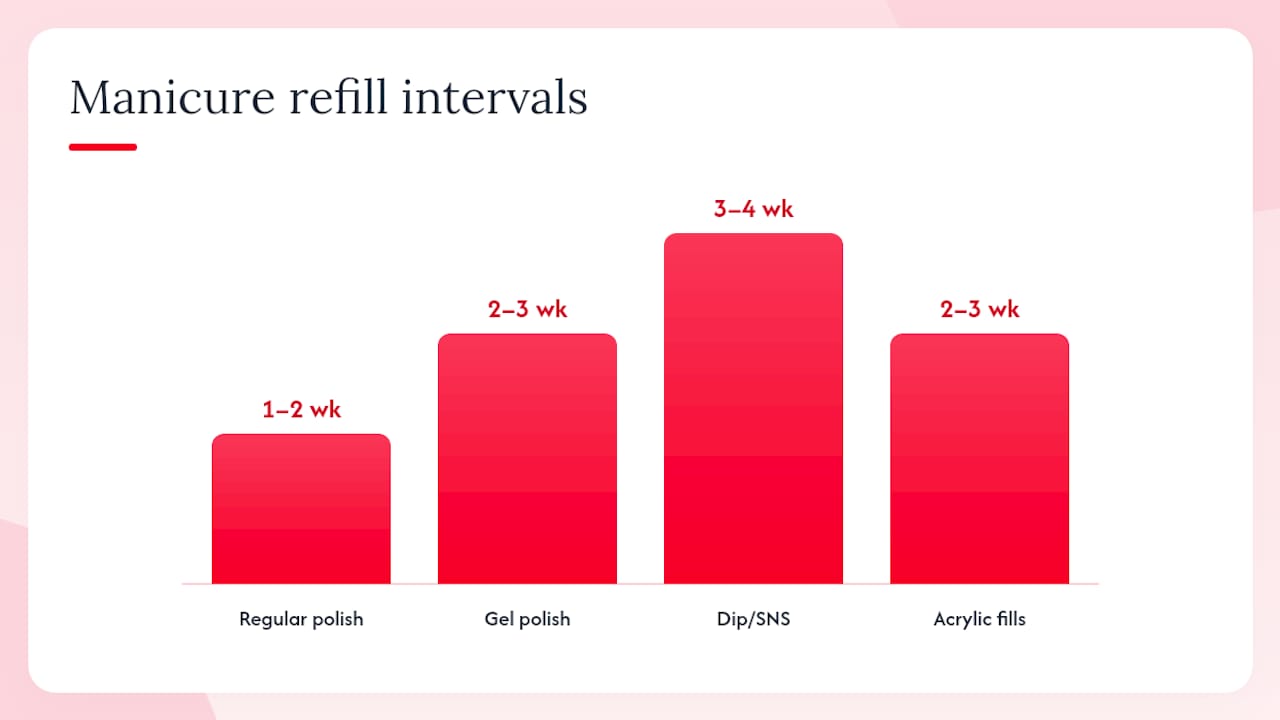
Most people should book standard manicures regularly, gel manicures approximately every few weeks, dip powder every few weeks to a month, and acrylic fills in similar periodic intervals. Those are the baseline ranges. What actually determines how often manicures are needed for you comes down to your nail growth rate, what you do with your hands daily, and whether your nails are signaling they need a rest rather than another service.
Here is a quick-reference breakdown:
Regular polish: every 1–2 weeks (sooner if you chip easily)
Gel polish: every 2–3 weeks, with a 1–2 week bare-nail break after every 3–4 consecutive sets
Dip powder / SNS: every 3–4 weeks; refill or full removal at the 4-week mark
Acrylic / extensions: fills every 2–3 weeks; full set replacement every 6–8 weeks
Natural maintenance only: every 3–4 weeks, or whenever cuticles look ragged and edges snag
One rule covers most situations: match your rebook window to how fast your nails grow and how hard your hands work, and schedule at least one bare-nail recovery week after every three to four consecutive long-wear sets.
Table of Contents
Signs you actually need a manicure (beyond the calendar)
A calendar reminder is a starting point, not a rule. Your nails will tell you when it is time, and sometimes what they are saying is “give me a break” rather than “book another appointment.”
Signs it is time to rebook:
Visible regrowth gap at the cuticle line (more than 2–3 mm on gel or acrylic)
Chipping or lifting at the free edge that catches on fabric
Edges that snag or feel rough when you run a finger across them
Cuticles that look dry, ragged, or are starting to peel
Signs you need a recovery break instead:
White spots or horizontal ridges on the natural nail plate
Nails that feel thin, bendy, or peel in layers after removal
Tenderness or pain around the nail bed
Repeated lifting within days of a fresh application (often a sign the nail plate is too thin or damaged to hold product)
Dermatologists and nail experts note that peeling nail beds and persistent irritation around the nail fold are signals to pause, not push through with another set. According to Yahoo Health, dermatologists emphasize that lack of hydration and improper removal are the root causes of most apparent damage, not the gel formula itself.
Pro Tip: Before booking, do a 30-second home check: press lightly on the center of each nail (a spongy feel means thinning), drag a fingertip across the free edge (any snag means the edge needs attention), and look at your cuticles in natural light. If two or more of those checks flag a problem, ask your technician about a recovery visit rather than a full enhancement.
What actually changes your ideal frequency
No two people need the same manicure schedule. These are the variables that shift the baseline ranges up or down.
Nail growth rate. Nails grow roughly 3–4 mm per month on average, but that varies by age, nutrition, season, and individual biology. Fast growers will see a visible gap on gel or acrylic within 10 days; slower growers can comfortably stretch to three weeks before regrowth becomes obvious.
Daily hand exposure. Typing all day is relatively gentle on polish. Dishwashing, cleaning with chemical products, or any manual work that involves water, solvents, or friction shortens wear time significantly. Water repeatedly breaks the seal at the free edge, which is why a gel manicure that lasts three weeks on a desk worker might chip in ten days on someone who washes dishes by hand.
Your goal for the appointment. If you are getting manicures primarily for appearance, you will rebook sooner. If the goal is nail strengthening or recovery, longer intervals with a focus on hydration and trimming make more sense.
Budget and time. Gel fills at a quality salon in the U.S. typically run $35–$55; a full acrylic set can run $45–$75 or more depending on length and design. Stretching intervals by a few days with good aftercare is a legitimate strategy, and it is better for your nails than rushing back before they are ready.
Technician skill and removal technique. This one is underrated. A technician who over-buffs the nail plate before application, or who peels product off instead of soaking it, compresses your safe frequency window. Professional removal, done correctly, is one of the biggest factors in how quickly you can safely rebook.
Skin and nail health conditions. Psoriasis, eczema, and fungal infections all change what is safe and how often. If you have any of these, check with a dermatologist before committing to a regular enhancement schedule.
Per-service guide: longevity, timing, and U.S. cost ranges
Here is what to expect from each major service type, so you can build a realistic calendar and budget.
Regular polish
Classic nail polish is the most forgiving option. It air-dries, requires no lamp, and comes off easily with acetone. The tradeoff is wear time: most people see chipping within about a week with regular activity, and a fresh look typically requires a new application every one to two weeks. A basic manicure usually costs between twenty and thirty-five dollars at most U.S. salons and takes about half an hour to three quarters of an hour. For a full breakdown of appointment timing, see how long a manicure takes.
Gel polish
Gel polish cures under a UV or LED lamp in roughly 60 to 90 seconds per coat, producing a chip-resistant finish that usually lasts a couple of weeks before visible regrowth or lifting appears. The Cleveland Clinic notes that repeated continuous use without breaks is linked to nail thinning, which is why most dermatologists recommend a bare-nail period after every few consecutive sets.
Removal should always be done by soaking in acetone, not peeling. Peeling strips layers of the nail plate with the product. A gel manicure at a U.S. salon generally costs between thirty-five and fifty-five dollars and takes about three quarters of an hour. For a comparison of gel versus regular polish longevity and removal considerations, this overview covers the key differences.
Dip powder / SNS
Dip powder (including SNS) bonds more firmly than gel and typically lasts several weeks before significant lifting or regrowth becomes visible. At about the one-month mark, most technicians recommend a full soak-off and reapplication rather than a refill, because the product can trap moisture and bacteria if left too long. U.S. pricing generally runs around forty to sixty dollars, with appointments taking about three quarters of an hour. You can book a dip powder service directly through Bradentonnails’ SNS page.
Acrylic and gel extensions
Acrylics and gel extensions (including Gel-X) require fills every few weeks as the natural nail grows out and a gap appears near the cuticle. A full set replacement is typically needed every one to two months, or sooner if significant lifting occurs. Full sets cost somewhere around forty-five to seventy-five dollars or more depending on length, shape, and nail art; fills usually cost slightly less. Appointments for a full set range from about an hour to an hour and a half. For safe removal guidance specific to Bradenton, see how to safely remove acrylic or gel nails.
Natural maintenance / strengthening manicures
If your goal is nail health rather than enhancement, a basic maintenance manicure every few weeks covers trimming, shaping, cuticle care, and a strengthening treatment or clear coat. These appointments typically cost around twenty to thirty-five dollars and take about half an hour to three quarters of an hour. They are also the right choice during a recovery period between enhancement cycles.
Service | Typical Longevity | Recommended Interval | Approx. U.S. Cost | Appointment Time |
Regular polish | — | Every 1–2 weeks | $20 to $35 | 30–45 min |
Gel polish | 2–3 weeks | Every 2–3 weeks | $35–$55 | 45–60 min |
Dip powder / SNS | 3–4 weeks | Every 3–4 weeks | $40 to $60 | 45–60 min |
Acrylic / extensions | 2–3 weeks (fill) | Fills every 2–3 weeks | $30–$75+ | 60–90 min |
Natural maintenance | Ongoing | Every 2–4 weeks | $20 to $35 | 30–45 min |
Statistic to know: A literature review published in ScienceDirect analyzing reported gel nail polish complications identified allergic contact dermatitis, mechanical nail damage, and UV-related lesions among reported issues. Allergic contact dermatitis developed after extended periods of repeated gel use, underscoring why symptoms can be easy to miss early on.
Aftercare steps that actually extend your manicure
What you do between appointments matters as much as how often you book them. A solid aftercare routine can add days to your wear time and protect the natural nail underneath.
Daily habits that make a real difference:
Apply cuticle oil once or twice a day, especially after washing hands. Dry cuticles lift and crack, which creates entry points for lifting at the nail edge. Jojoba-based oils absorb quickly and work well for most people.
Use a moisturizing hand cream after every wash. Hydrated skin around the nail reduces the mechanical stress that causes edge lifting.
Wear gloves for dishwashing and cleaning. Water and chemical cleaners are the two fastest ways to break down any nail product. A pair of rubber gloves costs less than a dollar per use and can add a full week to your gel manicure.
Smart at-home repairs:
Keep a small bottle of clear topcoat on hand. Applying a thin layer over the free edge every 3–4 days seals the tip and slows chipping. This works for regular polish and gel alike.
If a corner chips on regular polish, a drop of topcoat can buy you another few days without a full redo.
Avoid using your nails as tools. Opening packages, scraping stickers, and prying lids are the fastest ways to cause a break or lift.
When to use a buffer and when to skip it:
A fine-grit buffer can smooth a rough edge between appointments, but buffing the nail plate surface too often thins it. Stick to the edge only, and use a gentle motion. If your nails already feel thin or bendy, skip the buffer entirely and let them recover.
The Bradentonnails aftercare guide covers daily and weekly steps in detail, including how to use a strengthening topcoat correctly.
Pro Tip: Keep a small nail kit in your bag: a mini cuticle oil pen, a nail file, and a travel-size topcoat. A 60-second touch-up on a snagged edge or a dry cuticle can prevent the kind of damage that forces an early salon visit.
Health risks of frequent manicures and when to take a break
Frequent manicures are not inherently dangerous, but repeated long-wear services without recovery time carry documented risks. Understanding them helps you schedule smarter, not less.
The three main risk categories:
Mechanical damage: Aggressive buffing before application, improper removal (peeling instead of soaking), and over-filing all thin the nail plate over time. Clinical dermatology literature identifies mechanical and chemical causes as the primary drivers of nail cosmetic complications, and emphasizes that education and technique are the main prevention tools.
Allergic contact dermatitis (ACD): Methacrylate monomers in gel and acrylic products can trigger ACD in some people. The ScienceDirect literature review found that ACD was the most common complication in documented cases, typically developing after years of repeated exposure. Symptoms include persistent redness, itching, or swelling around the nail fold. If you notice these signs, stop the service and consult a dermatologist before resuming.
UV exposure during gel curing: The UV/LED lamps used to cure gel polish deliver a low dose of UV radiation per session. The ScienceDirect review found UV-related lesions in a small share of documented cases. Applying broad-spectrum SPF 30+ sunscreen to your hands before a gel appointment is a simple precaution.
Dermatologist-recommended recovery windows:
Medical News Today reports that dermatologists recommend keeping nails bare for at least 1–2 weeks between gel manicures and having gel professionally removed rather than peeled. If nails show signs of thinning, peeling, or persistent irritation, that window should extend to 4 weeks or more depending on how much recovery is needed.
The key point from Yahoo Health’s dermatologist review is that modern gel formulas are not the primary problem. Technique and hydration habits are. A well-applied, professionally removed gel set on a healthy nail is far less damaging than a DIY peel-off at home.
Signs you should take a break now:
Nails that feel soft or peel in layers after removal
Redness, swelling, or itching that persists between appointments
Nails that lift product within a week of application
Any pain around the nail bed or matrix
Sample schedules you can copy today
These are ready-to-use templates. Adjust the intervals based on your growth rate and the signs covered earlier.
Busy professional (appearance-focused, moderate nail health):
Weeks 1–3: Gel manicure, rebook at the 2.5-week mark
Week 4: Bare-nail recovery with daily cuticle oil and a strengthening topcoat
Repeat cycle; swap one gel cycle per quarter for a natural maintenance manicure
Low-maintenance (minimal salon time, basic upkeep):
Weeks 1–2: Regular polish at home or salon
Week 3: Touch up with topcoat or redo at home
Once a month: Professional maintenance manicure for cuticle care, shaping, and a fresh coat
Special-occasion plan (events, weddings, peak seasons):
2–3 weeks before the event: Full gel or dip powder set
Day of or day before: Touch-up or fresh application if needed
1–2 weeks after the event: Soak-off and a bare-nail recovery week before the next set
Avoid stacking back-to-back enhancement sets during a busy season without at least one recovery week between them
Adjustments for fast growers or heavy manual work:
Shorten gel intervals to 2 weeks instead of 3
Add a topcoat refresh at the 10-day mark to extend wear
Consider dip powder instead of gel for better adhesion under physical stress
For nail maintenance tips built around a busy schedule, Bradentonnails has a practical breakdown worth bookmarking
How a professional technician reads your nails
A good nail technician does not just apply product. They assess the nail plate before deciding what service is appropriate, and that assessment changes the recommended schedule.
What a technician checks at your appointment:
Nail plate thickness and flexibility (a thin, bendy nail is not ready for a full enhancement)
Condition of the cuticle and nail fold (inflammation or lifting edges signal a recovery visit)
Regrowth gap on existing product (more than 3 mm usually means a fill; significant lifting means a full removal)
Signs of fungal infection, psoriasis, or contact dermatitis (any of these changes the service plan)
When a technician recommends a recovery visit:
If your nails show thinning, peeling, or repeated lifting, a skilled technician will recommend a soak-off, trim, cuticle treatment, and hydration application instead of a new set. That visit typically takes 30–45 minutes and costs less than a full enhancement. It is not a downgrade; it is what protects your nails so the next enhancement lasts longer and looks better.
Bradentonnails’ approach follows the same principle: alternate heavier services with restorative visits, use professional removal every time, and build in bare-nail time after repeated gel or acrylic cycles. The gel manicure longevity guide covers the specific steps technicians use to extend wear safely to four weeks without compromising the nail plate.
Pro Tip: When you book, mention how long it has been since your last removal and whether you have noticed any thinning or lifting. That 30-second heads-up lets your technician prepare the right service before you sit down, which saves time and gets you a better result.
Key Takeaways
Matching your manicure schedule to your service type, nail health, and lifestyle is the single most effective way to keep nails looking good without causing long-term damage.
Point | Details |
Match interval to service type | Regular polish every 1–2 weeks; gel every 2–3 weeks; dip/SNS every 3–4 weeks; acrylic fills every 2–3 weeks. |
Build in recovery breaks | Dermatologists recommend at least 1–2 bare-nail weeks after repeated gel or acrylic cycles to allow rehydration. |
Technique matters more than formula | Professional removal and daily cuticle oil prevent most damage; peeling product off is the leading cause of nail thinning. |
Watch for warning signs | Thin, bendy nails, persistent redness, or repeated early lifting mean your nails need a recovery visit, not another set. |
Bradentonnails offers both | Bradentonnails in Bradenton, FL provides fills, full sets, recovery manicures, and personalized scheduling guidance in one visit. |
The tradeoff most clients don’t talk about
There is a conversation that happens at almost every nail appointment that rarely makes it into articles like this one: the moment a client says she wants a new set, and the technician can see the nail plate is not ready for one.
The honest answer in that moment is not “you need to wait.” It is “here is what we can do right now that will get you better nails in three weeks than if we push through today.” That is the difference between a technician who is selling a service and one who is managing your nail health over time.
The conventional wisdom on manicure frequency treats it as a fixed schedule, like a car oil change. But nails are living tissue attached to a matrix that responds to stress, hydration, and chemistry. The same gel formula applied to a well-hydrated, properly prepped nail will last three weeks and come off cleanly. Applied to a thinned, dehydrated nail plate, it will lift in a week and take a layer of nail with it when it goes.
What clients often underestimate is how much the recovery visit does. A 30-minute soak-off, trim, and cuticle oil treatment is not a consolation prize. It is the appointment that makes the next four sets look better and last longer. Skipping it to save time or money is the most common reason people end up with nails that “just don’t hold product anymore.”
The other thing worth saying plainly: the 1–2 week bare-nail recommendation from dermatologists is not a worst-case warning. It is a realistic minimum. If your nails are already showing thinning or peeling, four weeks bare with daily cuticle oil and a strengthening topcoat is not excessive. It is just what recovery actually takes.
Ready for a professional assessment in Bradenton?
Knowing the right schedule is one thing. Having a technician who can look at your nails and tell you exactly what they need right now is another. At Bradentonnails in Bradenton, FL, every appointment starts with a quick nail health check before any product goes on. Whether you need a fill, a full soak-off and reset, or a recovery manicure to get your nails back to a healthy baseline, the team will tell you which one fits your nails today, not just which one you came in for.

Bradentonnails offers gel, SNS dip powder, acrylic enhancements, and natural maintenance manicures, with flexible hours including Sundays for clients who cannot make a weekday appointment. If you have been running back-to-back gel sets and your nails are starting to show it, a single recovery visit at the salon can reset the clock. Book your manicure appointment online and mention at booking if you are looking for a recovery service rather than a new set. The team will have the right plan ready when you arrive. Check the salon visit checklist before your first appointment to know exactly what to expect.
Useful sources
The guidance in this article draws on dermatology literature, clinical reviews, and salon-backed resources. Here are the key references for readers who want to verify the evidence or explore further.
Source | What it covers |
Medical News Today: Are gel nails bad for you? | Dermatologist recommendations on recovery breaks and professional removal |
Cleveland Clinic: Gel nail polish and nail health | Gel longevity, curing method, and risks of continuous use without breaks |
ScienceDirect: GNP complications literature review | Documented rates of ACD, mechanical damage, and UV-related complications |
Clinical Dermatology review | Mechanical and chemical causes of nail cosmetic damage; prevention principles |
Yahoo Health: What gel polish is really doing to your nails | Dermatologist commentary on technique, hydration, and recovery timelines |
Bradentonnails: Gel manicure longevity tips | Salon-backed tactics for extending gel wear and safe removal guidance |
Bradentonnails: Nail care routine between salon visits | Aftercare steps including cuticle oil, gentle filing, and protective topcoats |
This article provides general nail care information and is not a substitute for professional dermatological or medical advice. If you notice persistent irritation, pain, or signs of infection around your nails, consult a dermatologist or healthcare provider.
Recommended
Comments